
A Roadmap for the Church of the Living Savior
Defining the Path Forward for the Church of the Living Savior, McFarland, California
Dr. Glenn Edward Layne
Transitional Pastor
May, 2014
The following is the full text of the report I wrote for the church as part of my interim/transitional work.
Who is the Church of the Living Savior trying to reach?
Meet Sal and Sandy. Sal is short for Salvador. Sal is a third-generation resident of McFarland. He married Sandy 9 years ago, and they have two children, a boy age 7 and a 5 year old girl.
Sal works in agriculture, just like his father. But unlike him, Sal is a manager. He makes just under $40,000 a year. Sandy works part time at an insurance office in Bakersfield. She went to community college; Sal didn’t.
Sal is proudly Hispanic, but not in the same way as his parents. He speaks Spanish, but any given day speaks as much English as Spanish. Sandy’s mom was Hispanic, but not her dad, and she doesn’t speak much Spanish. English is the language most spoken at home.
Sal was raised Catholic, but only goes to church a few times a year or for a wedding, funeral or baptism. For him, church is just not relevant. Sure he believes in God, but church feels--weird. Whenever he’s in church, he’s just not comfortable.
Sal and Sandy are the future--the potential future--of the Church of the Living Savior. The church’s past was based on Brethren profile families: white, ancestry in Northern Europe, often with multiple generations of Brethren affiliation and tradition, transplanted from the eastern US to the central valley of California, plus an added layer of non-Brethren ancestry whites who adhered to the church.
That past is gone. And it’s not coming back.
I am reminded of a consultation that an old acquaintance of mine, Dr. Ian Chapman did for a church in Columbus, Ohio. At the time he was president of Northern Seminary in Chicago. After a series of meetings he gave his recommendations. One present asked in a sarcastic tone, “So what if we don’t do these things?”
Ian Chapman is a soft-spoken man, so in a gentle tone he replied, “Well, then you close.”
It’s important to know when you driving are toward a broken bridge. Dr. Chapman knew the bridge was out; often when we’re on the road, that can be hard to see. That’s especially the case when you’ve been on the road for a long time: it’s hard to believe that the road can end.
What I present in this report is a roadmap that takes the church on a road that bypasses the broken bridge to a new bridge to the future.
The new bridge is respectful of the past, and the Brethren legacy of the church, without seeking to duplicate that past. For a variety of reasons, reproducing the past is simply not possible.
The single key to this new bridge can be summed up in these few words: reach Sal and Sandy. I’m asking that we see everything through their eyes. EVERYTHING.
That means that while being compassionate and respectful to the existing membership, the church has to decide whether it’s a church that exists to benefit its members, or a church that exists to benefit those who do not yet follow Christ.
How do Sal and Sandy see a church like COTLS? What’s the most likely avenue to bring them through the doors? What are their felt needs, and how can COTLS tap into that sense of need?
How do they see the physical church plant? When they come through the doors, what do they see--and what are the looking for? What is their experience of worship? Of fellowship? Of children’s ministry (that’s their real, felt need priority--not peace with God!) How do they see elements like spiritual growth, serving, sharing faith, giving?
In the course of this report, we will from time to time do a S&S Check--that is, to try to see things through the eyes of Sal and Sandy.
Introduction
The purpose of the study is to examine the relevant data regarding the Church of the Living Savior (COTLS) of McFarland, California to produce a workable roadmap of implementation. At times, straightforward recommendations will be made. Sometimes implementation options will be offered.
Implementation options are decisions that must be made; if not, circumstances will make de facto decisions, most of which will be negative. Some of these decisions may be made by the next pastor, some by the leadership team of the church right away and some will need to be made by the congregation at large.
The whole ministry of the church will be examined, processed through four differing but complementary matrices:
- One: the Four Pillars of Ministry (developed by Glenn Layne)
- Two: the Five Purposes of the Church (popularized by Rick Warren)
- Three: the Eight Systems of the Church (developed by Nelson Searcy)
- Four: Results of the Study Done by Mark Lambert of Transformation Ministries
The discussion of the Five Purposes and the Eight Systems will be intermingled.
This will be followed by a list of specific action steps recommended in a calendarized format.
There are appendices describing all three of these approaches in detail. There is also an appendix dealing with issues of mission and vision.
The Four Pillars of Ministry and COTLS
Over the last few years, I’ve given much thought to balance in the ministry of the church. Maybe it’s because as I age, I see areas where I, or the churches I have served, were out of balance. In 2010, I blogged on the topic and incorporated what I call the Four Pillars of Ministry into a class I taught at California State Christian University in 2011. I have had opportunities to share the Four Pillars to pastors individually and in groups since then, and I have seen eyes light up with enlightenment as I share it.
The Four Pillars looks at ministry activities from the standpoint of those in pastoral leadership. It is a general guide on how to distribute time and energy
Like a great building, the four pillars must be equal at the four corners of the church. However, there is a logical progression, moving from the knowledge of God to human relationships and activities.
The First Pillar: Right Faith
By Right Faith, I mean sound doctrine, based on Scripture, centered on Christ, certain and settled on all essential truths of the faith. The starting place is always God. He wants us to know Him rightly. Doctrine matters because doctrine is all about who God is, what He is like, what He does and what He commands us to do.
Some questions to ask based on the First Pillar:
Are you well grounded in Scripture? Are you constant in your study of Scripture? Is your understanding of what we believe and why we believe it growing?
Pastoral role implication: you, as pastor, are called to be theologian in residence for your congregation. What is your strategy to keep growing as a student of the Scriptures and of sound theology? What’s your Bible reading plan? How are you growing in your understanding of theology?
Church role implication: to be ever-learning disciples; to be like the Bereans (Acts 17:11). A very significant part of the reason the church exists is to teach sound doctrine.
I would contend that approximately one-quarter of an effective pastor’s time needs to be devoted to Right Faith issues. That would include sermon preparation and Biblical and theological study. If we factor a 50 hour week, that works out to 12.5 hours a week.
The Second Pillar: Right Devotion
The second pillar includes passionate worship and personal devotion to God expressed in corporate worship, attention to Scripture, daily prayer and commitment to continuous spiritual growth. God calls us to have more than right faith. He wants us to have a vital, passionate relationship with Him. The Pharisees knew plenty of doctrine, and it was 90% correct, but Jesus said their hearts were far from God.
Some questions to be asked on the Second Pillar: What’s your spiritual temperature? What’s your quiet time with God like? Are you able to worship with passion and abandon? Are you closer to God today than you were this time last year?
Pastoral role implication: pastors are called to be spiritual mentors, to lead people in prayer and growth in a wide array of spiritual disciplines. This includes leading people in corporate worship. Pastor, what is your strategy to keep growing in your personal time spent with God that deepens your walk with God, deepens your prayer life and that gives you the opportunity to teach and lead by example this life to others?
Church role: to be holistic worshippers, who are growing in personal devotion to Christ, growing as people of prayer and are capable of fruitful devotional reading of Scripture and growing in the wise use of spiritual disciplines.
This also should occupy about a quarter of a pastor’s time: daily time with God, retreat time with God, leading people (individually and in groups) as they seek a closer walk with God. This time is often spent in blocks of time rather than weekly hours.
The Third Pillar: Right Relationships
The third pillar pertains to the people of God in relationship: speaking the truth in love, compassionate, kind, humble, gentle and patient; generous in forgiveness, brimming over in love. We turn that same commitment to love God toward one another. Jesus said that our love for one another would be the evidence to the world that we are His disciples.
My friend Steve Robbins (www.robbinsnestministries.org) did a survey at a church conference asking the question, “What’s holding your church back from its potential?” His discovery: BMWs! By that he meant “busy-ness, meanness and worldliness.” All these are relationship killers: when we’re too busy to develop and cultivate relationships, when we are downright mean and rude to one another, and when we allow the world to contaminate our hearts.
Pastoral leadership role: shepherd of the flock. The model is the Lord Himself who seeks the well-being of the sheep (Psalm 23) and develops a personal connection to each of the sheep (John 10:2-4).
Church role: koinonia (fellowship, mutually dependent) body of Christ. “Fellowship” isn’t sharing coffee and a cookie before the morning service. Fellowship is a sanctifying friendship of love, care, concern and correction. Fellowship dovetails into the Biblical doctrine of spiritual gifts, which in their diversity are designed to lead us into a supernaturally mutually dependent relationship with one another (1 Corinthians 12:4-11). Fellowship isn’t simply “family”; it means a body of believers united in order to model and proclaim something bigger than themselves: the kingdom of God.
Pastors and leaders: How do you stay aware of personal needs of the flock? Do you have a systematic way of staying in touch of these needs? How much time do you spend with your people? And how engaged are you when you are with them?
Again, I would contend that aiming at one-quarter of the pastor’s time devoted to being with the people, and addressing specific needs and situations is ideal for pastors. This includes time with non-believers—evangelism time.
How high up are relationships in the body of Christ on your priorities? Pastor and leaders: while all your efforts may not be reciprocated, are you making an effort to develop, deepen, and repair relationships?
Nothing destroys a ministry faster than the sense that those in leadership don’t care or are out of touch with their everyday concerns.
The Fourth Pillar: Right Practices
By this we mean the application of the best practices in administration, ministry and outreach throughout the ministry of the church. Many of us have heard the term “best practices” from our workplace. There are “best practices” when it comes to ministry as well: there’s a right way to evangelize, to connect people, to disciple people, to encourage stewardship, and so forth. But “right practices” come last. You can’t lead with right practices unless right faith, right devotion and right relationships are in place.
Pastor and leaders: are you striving to do what you do better than you’ve done it before? Are you striving to be a learner, a grower and goer than strives to do your “utmost for His highness”? Do you seek out opportunities to grow in service? To add skills related to management and best practices?
Church role: being a missional (that is, having a kingdom assignment that changes their world) body. “Missional” is perhaps the most over-used word to emerge in church circles in the past ten years. But what I mean here is very specific: practices related to evangelism, assimilation, leadership, ministry, missions, small groups, stewardship, strategy and worship.
Pastoral leadership role: innovative church manager. By “manager” we’re talking about the fact that golden dreams need to be achieved via many wooden steps—that vision needs simple, understandable and desirable steps to move forward toward that vision.
This is not a role that most pastors enjoy, seek or are skilled at. People become pastors because they love God, they love His word and they love His people. But like Nehemiah, they learn that loving the Lord and His people still requires the hard and tedious work of building the walls of Jerusalem.
The single best source of Right Practices for churches I have discovered is the material produced by Nelson Searcy of Church Leader Insights, and Lead Pastor of the Journey Church of New York City and Boca Raton, FL. I recommend that the next pastor of COTLS join Nelson’s coaching network as soon as reasonably possible (see his website, www.churchleaderinsights.com).
The church is made up of people. In 1 Peter 2:5, Peter says that we are “living stones…being built into a spiritual house.” (Paul says much the same thing in Ephesians 2:19-22). How balanced are you as a stone in the house of God? Where do you need to grow and change? Which corner—faith, devotion, relationships and practices—needs to be shored up? Are you willing to work on it?
COTLS and the Five Purposes of the Church
In recent years, the “purpose driven” model that has become well-known through in the ministry of Rick Warren of Saddleback Valley Community Church in Lake Forest, California. All churches are “driven” by something—traditions, denominations, the perceived needs of the members, even the desire to appeal to the surrounding community. The purpose driven model asks, “What were the priorities of Jesus?” Instead of starting by asking what you or I or other people think, what were the driving purposes of Jesus?
By examining the Great Commandment (Matthew 22:36-40 and parallels) and the Great Commission (Matthew 24:19-20), five purposes emerge:
1. “Love God with all your heart” = WORSHIP
2. “Love your neighbor as yourself” = MINISTRY
3. “Go...make disciples” = EVANGELISM
4. “Baptizing them” = FELLOWSHIP
5. “Teaching them to do” = DISCIPLESHIP
My experience is that if you gather a group of Christians together and ask them what the purposes of Jesus are for His church, the group will usually come up with four out of five of these (and the one left out is not always the same). If you suggest the fifth item, the response is usually, “Yes, we should add that one too.”
Tom Mercer from High Desert Church in Victorville, California adds a good point: there’s only one of the five that I can only do now, here on earth: evangelism. It’s the priority purpose for life on earth.
Numerous Biblical passages confirm the fivefold purpose of the church: Jesus’ ministry modeled these 5 purposes in John 17:1-26; the first church fulfilled these five purposes in Acts 2:41-47; Paul explained these five purposes Ephesians 4:11-16.
In addition, Purpose Driven is easily explained and lends itself to easy visual representation, such as the famous Saddleback baseball diamond:

PD encourages sequential thinking. Church is going somewhere: there is the conviction that God’s desire is to move people forward from conversion, to fellowship and discipleship, to service/ministry (inside the church) and mission/evangelism (outside the church).

Let’s examine the Five Purposes of the Church as it relates to the ministry of COTLS:
Worship
What is worship and who is it for?
I took a class on world missions at the US Center for World Missions in Pasadena, CA in the summer of 2005. One area we covered was the role of music in world missions. The big take away from that was this: each culture is convinced that their preferred form of worship was the only right one!
In a way, this isn’t surprising. We do what we do out of our experience. So, if we were raised with “traditional worship” (which in white churches is basically late 19th-early 20th century Euro-American music), then we will take it for granted that “that is the right way to worship.” If we weren’t, then we are most likely to prefer music that comes from mid to late 20th century music forms (rock, country and jazz).
Worship is an organized way of loving God, mostly done together in song, prayer, and word. In that sense, worship is “for” God. But it’s also for us: for us to turn to God in love, to change our priorities and to unite our love, mind and body in focus on the greatness and goodness of God.
In the case of the class I took at the US Center for World Missions, one of the music forms we heard (by recording) was Eskimo throat-singing, which may be one of the most bizarre music forms a westerner can hear. To these people, the idea that God could be worshiped by any other music not only struck them as inappropriate, but as revolting. Throat-singing is “proper” worship!
Historically, Christians have battled over worship whenever a shift in worship music occurred. We have no records of how going from Semitic (Middle Eastern) forms to Graeco-Roman forms went, but just imagine the strife that happened when those forms shifted to chant, and when chant went to the congregational singing of the Reformation. In his Lectures on Revival of Religion (1868), Charles Finney mentions the strife over worship in the US church in the early 19th century caused by the introduction of the “noisy, obnoxious” instrument: the organ! (He also mentions how upset people were with pastors who abandoned knee-britches for full-length pants.)
Two quick lessons to take from this historical perspective: first, when music forms change, some people are always upset because they feel that their “worship language” has been taken away. Second, we have to see that a change of worship style is not a degrading of worship. It is bringing to the people of the time, in a music language that they speak.
I recommend that these actions be taken:
- There needs to foundational theological teaching on worship, both from the pulpit and in small groups. The pastor, as chief theologian in residence, needs to take responsibility for this. It is essential that the definition of worship be fully understood, as lives fully honoring God, not merely as the singing of songs (see Colossians 3:16-17).
Worship is never performance. It is the act of loving and honoring God. On the other hand, as something given to God, it is to be done with excellence and devotion, never done in a “slapdash” fashion, since public worship’s intent is to draw the heart of the worshipper upward in love.
Worship is not historic preservation. It neither follows the latest musical fad as the best, nor does it prop up the old—or the ancient—as the blessed and true form of worship. It asks the question, what honors God and also connects with and moves worshippers into a deep, soulful appreciation of God and His gracious deeds? That is good worship.
- Invest in the quality of public worship. At least a portion of the “worship wars” conflict is a perception that the other side’s approach to worship is shabby. New wave worshippers speak of the “dirges” of traditional hymnody; traditionalists wax eloquent on the loss the “great old hymns of the faith”, implying that their preferred style is “great”, and those other styles, no so much.
Many musicians I know say that there are really only two types of music: good and bad. I know classical music fans who also appreciate jazz and country—as long as it’s done well. Building on the foundational truth that worship is an action of devotion to God, it should be done well. Therefore, employ good worship leadership, give them opportunities to grow in their role, and fund continuing education (especially exposure to good models).
I recommend that those in worship leadership explore and perhaps join the coaching network of Jason Hatley (www.worshipleaderinsights.com), which is closely allied with Nelson Searcy’s churchleadersights.com. Hatley’s weekly email always contains good insights (while also selling his website’s services).
- Invest in the durable goods needed for quality worship. This means musical instruments, written music and appropriate technology. The church has wisely invested in projection equipment, sound systems and computers needed to do the job.
The projector needs to be mounted, something I understand to already be in the works. Also, a team of operators needs to assume responsibility for running the projector--not people on the worship team. 2-3 trained people are all that’s needed to start. This is also a very good job for teens.
One recommendation on equipment: I suggest either buying a large-screen monitor placed at the back of the sanctuary to enable singers to see the words (rather than having to look at words on paper) and to enable speakers to see the PowerPoint they are using without turning around or to purchase a monitor they can see upfront.
All this is predicated on getting reliable internet access in the worship center. Appropriate tech to boost wireless connectivity from the office area is needed.
4. Keep the offering in the worship service. There are good theological as well as practical reasons for this.
Theologically, giving is part of worship. It is part of responding to God. As a response, I strongly prefer to have the offering after the message. Having an offering teaches the value of giving in the most direct way.
Practically, having an offering encourages giving. Remember this rule: never make something difficult that you desire to have done. Make it as simple as possible. It may seem simple and easy to have people drop their giving into boxes on the wall, but that requires far more intentionality that dropping an offering to an offering plate. You can walk past the boxes for weeks on end, but you can’t walk past the offering plate right in front of you.
This intersects with two other things: assimilation and fellowship. When newcomers are in worship, it is essential to gather their information for follow-up. The best way to do that is by having people (ideally everyone every week) fill out a “communication card,” and the best time to do that is at the end of the worship service in conjunction with the weekly offering. The principle of the simple step extends to the snack time after the service: I strongly suggest that the snacks be served in the lobby, not the fellowship hall. (Even better, make them available as people come in as well.) Even the simple act of walking down the hall to the snacks cuts at least 50% of the people out. Having the snacks in the lobby will encourage more people to stay, and in that time, people talk to one another. In that talking, fellowship happens, and opportunities for connections lead to a deeper walk with God, growth, and ministry opportunities.
In addition, I am loading information from the Worship System segment of Nelson Searcy’s coaching network onto the pastor’s computer.
Time of service
A survey was conducted on April 27, 2014 asking the following (with results):
Please check the responses that best represents your viewpoint.
10 I like our current schedule (10 AM worship followed by classes at about 11:15)
5 I would prefer classes first at around 10 AM followed by worship at 11 AM.
2 A schedule change would make it harder for me to be here.
0 A schedule change would make it easier for me to be here.
14 It doesn’t really matter to me. I’m OK either way.
The big winner was--it doesn’t matter to me. If that’s the case, then we are free to set the schedule based on other factors. One good but hard principle that effective churches discover is that when there is a choice to be made between member privilege versus mission accomplishment, mission must be allowed to win, so “it doesn’t matter to me” here is a good thing.
Back in the 1990s when many churches were adding a new “contemporary” worship service, one mistake commonly made was to add the new service at the time the target group (young adults) were least likely to come (say, 8:30 AM).
The very people they wanted were mostly still asleep!
On a smaller scale, having the worship service at COTLS at 10 AM as opposed to 11 AM is a small deterrent to reaching the Sal and Sandy families that are the future of the church. I recommend moving to 11 AM, although I recognize that the advantage is fairly small.
S&S Check
What about Sal and Sandy’s perspective on worship? Here are some factors that Sal and Sandy process when experiencing worship:
1. Is it of good quality? They are consumers of movies and TV, and while they know a local church can’t compete with Hollywood’s budget, they will wince when things appear to be slapdash and last minute.
2. Is the music “churchy”? Listening to 19th century styles in the 21st century makes them cringe. By the way, when older styles are mixed with more contemporary styles, that’s not so bad. At least they (the people in the church) know what century they are in.
3. Is worship for insiders? Are all kinds of things referenced that only insiders understand? Are people referred to by first names because “everyone knows who they are”? If so, Sal and Sandy wonder if they’ve broken into someone else’s club.
4. Do the topics addressed touch their lives? Is the message and the worship experience relevant to their lives? Do they answer their questions or speak to their concerns?
5. Do they see evidence of changed lives? Church talks about changed lives all the time. Do they see evidence of lives really being changed? (Baptism is a great forum for evidence of life-change, especially the baptism of adults and people who are like Sal and Sandy.)
6. Are they being engaged on an emotional as well as intellectual level? This is an evaluation they are making without thinking about it, but it’s very important.
Ministry
By ministry, we mean the loving service rendered primarily (though not exclusively) to other believers. It is the manifestation of Jesus command to “love one another” (John 13:34-35). The Holy Spirit distributes His gifts to enable us to do this ministry (1 Corinthians 12:4-11).
How to develop people’s faith--and how it relates to ministry
In Deep and Wide, Andy Stanley talks about five catalysts to spiritual formation, and these five relate to ministry. It’s been the experience of Northpoint Church, Stanley’s church on the north side of Atlanta, that these five elements are essential ingredients to spiritual growth.
The five are:
1. Practical teaching
This is teaching of the Scriptures with a great stress on application. The Bible comes alive when we see how it connects with our lives. The teaching of the Bible needs to be truthful, but also helpful and enjoyable.
2. Private disciplines
Having a personal time with God is essential for growing Christ-followers. The church needs to resource and teach on this.
3. Personal ministry
The next big faith-builder is personal ministry. 95% of people feel inadequate the first time they engage in ministry--and the other 5% can’t be trusted to tell the truth!
People learn best when they have to! Project people into responsibility before they seem up to it. Too much of discipleship has been designed as classroom experiences, which is ineffective for the life change that following Christ is supposed to effect--especially for male learners.
4. Providential relationships
God drops people into our lives in whom we see God or through who we hear God. Churches facilitate that by having groups that stick together for longer time segments.
5. Pivotal circumstances
These are defining moments--sometimes crises, sometimes blessings--that shape (or break) us. The way we interpret these events is in turned shaped by who were are sharing our lives with, and the church’s role is to provide relational contexts for people to live in to turn Godward.
The point for us is this: discipleship (spiritual growth) and ministry are co-mingled. While we can separate the two for analytical purposes, they actually happen together--just as in the gospels as Jesus taught the twelve. He didn’t put them in a class for a year before they hit the road. They went straight to the road and learned and they went.
Ministry also overlaps with mission, but while ministry and mission have a natural overlap, I am separating mission (evangelism) for later treatment.
Children’s Ministry
S&S Check
Parents are fanatics for their kids, and Sal and Sandy are no exception. Here’s what they are looking for:
1. Do the kids enjoy it? I mean really enjoy it, to the point that they’d miss it if they weren’t there for activities?
2. Is it clean? It doesn’t have to be germ-free, but parents demand a higher standard for space where their kids are than they do at home.
3. Do the volunteers seem to know what they are doing? And do they seem at all creepy? Parents’ tolerance for creepy people around their kids is about zero. Churches have a bad reputation in this area. That may not be fair, but that’s the way it is, and that’s what matters.
4. Does it seem safe? Tables, chair and equipment that looks old and uncared for is a good reason not to come back.
So what’s the present state of children’s ministry at COTLS?
We have few children--and at the same time a community reputation for effectiveness in children’s ministry. The evidence for that is in the well-attended VBS (Vacation Bible School) that the church conducts each summer. That’s an interesting paradox.
However, VBS hasn’t translated into these children and their families “sticking.” How can that happen?
I am recommending a rather dramatic departure from current practice to strengthen this area, boost attendance and make children’s ministry much more “sticky” for both children and their parents.
Here’s the problem: few kids, limited resources, untidy rooms, overworked volunteers. Great efforts expended--and little to show for it.
Part of the problem here is trying to run a model that is dated. Sunday school was modelled on public school--smaller and with fewer classes, but a sit-down around a table experience.
Let’s start with the fact that the traditional Sunday school is rougher on boys than it is on girls. Boys are wired for action. Sit around the table, read, listen to the story and color--that can be torture for a 9 year old boy.
Now add this to the mix: thanks to media saturation (movies, video games, etc.) the sit-down Sunday school class strike many boys--and girls--as just plain boring.
At this point, we may object that it shouldn’t be that way. Motion sustained. But that’s just irrelevant. If we want to reach Sal and Sandy’s kids, our preferences don’t matter. What matters is how these kids tick.
What is needed is a far more visual, kinetic (motion-oriented) and immersive approach to children’s ministry. Or to put it another way--how can we make Sunday school a whole lot more like VBS? Is is possible to have a VBS “vibe” every week that draws and retains kids and then opens the way for their families?
The basic concept is a weekly experience that is more like VBS or AWANA and happens on Sunday morning. Sunday school is transformed into something like “Adventureland” (call it what you will) with a central hub, moving kids from station to station in rapid order. For example, one church has this set-up--eight “stations” kids moving from place to place all in about an hour:
- Parable Place (storytelling)
- Activity Alley (games and activities)
- Divinity Diner (food)
- Luke's Lab (science)
- Creation Station (art)
- Visual Vineyard (video)
- Music Mall
That’s--a lot! But this doesn’t have to be expensive or that complicated. It can be as simple as tables in fellowship hall with dividers, or rooms in the educational wing repurposed. It can start simple and can ramp up as numbers grow. The minimum is opening, story, activity, closing. It must involve video, music, movement and hands on activities.
Many churches are discovering that this approach is what works for them. One limiting factor that many churches have is lack of large space to make the central hub for the children’s ministry experience--a problem that COTLS doesn't have (the fellowship hall is perfect--once it gets a few repairs).
The best resources I have seen for this approach are available from ThinkOrange.com. Think Orange encompasses what used to be 252 Basics (based on Luke 2:52). Think Orange now resources from pre-K through High School.
I would say that winning at children’s ministry is so important for COTLS that it should be the deciding factor for the Sunday morning schedule and if it’s necessary to cut something else in order to excel at children’s ministry, it should be done.
Having the children do things in the worship service that they can invite their families to is part of the bridge to get their parents in worship. The children can sing, or do a short play, as soon as six weeks after “Adventureland” begins. Harvest party (around Halloween) is another; a Christmas party (“Birthday Party for Jesus”) is another.
Youth Ministry
Just a few years ago, this was a viable part of the ministry. Now it’s a wasteland. The dearth of teens reflects the demographics of the church: there are no teens when there are no parents in their late 30s and 40s. This is clearly the church disaster area.
It is often said that “youth are the future of the church.” I disagree. Youth are the present of the church:
- Youth disproportionately participate in all forms of outreach.
- Youth disproportionately participate in all forms of world missions outreach.
- Youth disproportionately participate in all forms of worship activities.
Not only that, when youth ministry is weak, their parents’ age group (35-50) are also lost to the church. What few parents are in this category will shop elsewhere for a church home. That’s a present loss, not a future loss.
That being said, a few words about the interaction between children’s and youth ministry:
A common mistake made is to train children and to reach youth. So, for children we have VBS, Awana, Bible drills and so forth. Then for youth, we have concerts, retreats, rallies and we largely abandon training.
That’s backwards, isn’t it? Don’t we ramp up the education of children to youth as they grow up?
It’s not that training isn’t good for children. It is. But why do we abandon it for youth? Why do we assume that youth have no interest in training?
Many years ago, I was on the board of Bill Rudge Ministries of Hermitage, Pennsylvania (www.billrudge.org). That ministry came into being in part because there were many small churches in the area, with plenty of youth, but there were few churches that could afford a paid youth pastor. Bill Rudge effectively served as youth pastor to hundreds of kids in the area. He taught me that there are three kinds of events or experiences for youth:
- Image-building. An example would be a trip to Seaworld that we lent our church bus for.
- Outreach. A Christian concert with an appeal to believe that gospel would be an example.
- Discipleship. This would be gatherings of groups, large and small, to receive Bible teaching to apply it to life, learn Biblical worldview, and to improve godly decision-making skills.
BRM supplied youth ministry to our church (Calvary Baptist, Hermitage, PA), where we never had more than 5-6 teens.
A few observations:
We tend to handle teens “with kid gloves”, expecting far too little from them in terms of effort, commitment and mental energy. Yes, teens want to be entertained (as do their parents and grandparents!), but they also want to be challenged to be engaged in something larger than themselves.
An all-pervasive nihilism swirls around the lives of teens. Is life just about video-games, having sex and getting high? Early teens especially are natural philosophers, asking the big questions. We (the church) are the only ones with the big answers.
Christ’s church has a two-fold opportunity:
- To supply high-level answers to life’s toughest and most profound questions.
- To enlist this lost generation in a world-changing movement to the glory of God.
A matter that complicates youth ministry in the McFarland is the fact that a very large portion of the teen population is Hispanic. There is a one-degree separation between their family culture and the white/English-speaking culture of a churches like COTLS.
So, what is to be done?
- Getting children’s ministry and youth ministry where it needs to be will take time.
- Children’s ministry needs to be the current priority.
- Turn children’s ministry into a form of outreach. I’ve already addressed this. Children’s ministry may be the single best form of outreach for COTLS for the present time. Ask, how can we do children’s ministry in a way that successfully reaches children out in the community?
For some additional good models on more street-oriented children’s outreach, see:
As well as…
All street children’s ministry needs to have Spanish-speakers involved. That’s the biggest problem with street children’s ministry as compared to the “Adventureland” approach discussed above.
- As children age, we need to be prepared to minister to them, rebuilding our youth ministry as they grow up.
- For the present, as much as we’d all like to have a thriving youth ministry, we must invest time, energy and money into children’s ministry.
Adult Ministries
I will discuss adult ministries under discipleship.
In addition, I am loading the segment from Nelson Searcy’s training on the ministry system on to the pastor’s computer.
Evangelism
For our purposes, let’s define evangelism as broadly as possible: presenting Jesus Christ and His church to the not-yet believing world.
This very broad definition covers what might be called marketing as well as the direct presentation of the gospel. Recall the Bill Rudge formula: some things that the church does are image-building, some things are evangelistic, some disciple-building. You can think of the image-building activities as “pre-evangelistic.”
What are some specific image-building activities that COTLS should give attention to?
Online presence
Church website
The church desperately needs a website. Today, a church is examined from the “outside” three ways: (1) website , (2) physical appearance and (3) attending a worship service. That is often the order of examination. If outsiders cannot even access step one, they are unlikely to go on to step three.
When it comes to a church website, my criterion is attractiveness, ease of navigation and ease in editing/altering. A low-cost option is Outreach Websites, which offers a $49 per month option for churches under 100. Staying at that level, the five year cost is about $3000.
There is also Cloversites.com, a company I trust and have used before. Clover has a one-time fee of $1000, plus $20 per month, a five-year cost of $1960. I recommended Clover.
Social media: Facebook and Twitter
As of March 7, the has a Facebook page. Facebook is the most efficient tool for in-church online social networking. People are used to it, and all communication is in the clear (as opposed to an online forum, where people can “run wild” anonymously).
Having a church Twitter account is unimportant at this time.
Online newsletters
Online direct advertising via email can be done for as little as $15 per month using Constant Contact or iContact. As of April 2, we have a Constant Contact account. I have prior experience with them and know how easy it is to use: hundreds of templates, up to 500 email addresses and unlimited mailings per month.
Online rating and advertising
After getting the new and improved website, use the Facebook page to encourage members to make positive comments on the church (instructions can be placed on Facebook for Google, Yelp and Yahoo reviews).
Other Advertising: Newspaper/Yellow Pages
I do not recommend paid newspaper or Yellow Page advertising. This was a fairly good investment as recent as the mid-90s, but is not now due to the dominance of the internet.
Community involvement
Involvement with recognized community change agents is a helpful element in pre-evangelism. They key thing is to find the appropriate local organization. The objective is quite simple: community influence. Organizations include the local Chamber of Commerce, Rotary, etc.
Facilities as Outreach Tool
COTLS should seek to make the building available to more outside organizations, such as after-school programs, vocational training, ESL classes, Chamber of Commerce meetings, exercise classes, etc.
Aside: Getting the Plant Up to Date
The physical condition of the church plant is wanting. Making it fully up to date would take an enormous amount of money and effort. Churches often make the “Field of Dreams” mistake: “If you build it, they will come.” Buildings have a marginal impact on evangelism. But buildings in bad shape have negative impact on attracting people.
A long term plan of repair and upgrade should be made starting with the most visible areas (lobby, worship space and exterior). Exterior doors that are in poor shape should be replaced with weather resistant doors in a logical order. The key thing is not so much speed as consistency--”gentle pressure constantly applied.”
Oikos (network) evangelism
Tom Mercer of High Desert Church (Victorville, CA) has popularized the term and concept of Oikos evangelism (see his website, www.8to15.com).
Oikos is a New Testament Greek word meaning extended family. Mercer has seen High Desert grow from a church of 100 to over 11,000 by teaching his people that their “world” is the 8-15 people with they share life most closely, “your sphere of greatest influence, your relational world.” Mercer says that your Oikos is the most natural and common environment for evangelism to occur. Says Mercer,
From the beginning of His redemptive plan, God has consistently focused on a specific group, the Oikos (as the Greeks called it) as His primary target for evangelism. That is, He primarily perpetuates His Kingdom through those close social connections that we all have, those eight to fifteen people He strategically placed around each one of us in our own relational worlds. Throughout the New Testament, whenever God’s Spirit changed a life, a world-changer was born. Whether it was a demon possessed man, a swindler named Zacchaeus, a royal official with a dying son, a tax collector named Matthew, a Centurion named Cornelius, a businesswoman named Lydia or a recently unemployed Philippian jailor, they all were sent back home to their Oikos. While different cultures and generations reflect unique qualities, the Oikos phenomenon remains a constant, a core characteristic of humanity’s hardwiring.
Oikos can be summed up as simply this: work your natural network of relationships for Christ. I have taught people to reach “Frank”:
- Friends
- Relatives
- Acquaintances
- Neighbors
- Ko-Workers
Working your Oikos in the run-up to Easter, Christmas and to Big Days (see below) is an essential part of church’s growth. Mercer emphasizes that the Oikos principle must be constantly and gently taught to have an impact on the church.
Heart of Darkness Principle
This is the name I’ve given to the principle that people are attracted to churches who take a gentle but firm stand against some key local expression of true evil. This empowers the church as they stand in the power of the Holy Spirit (Ephesians 6:10-20).
A Biblical example of this can be found in Jesus seeking out the Gerasene demoniac (Mark 5:1-20). This man’s deliverance and conversion rippled out to bless the Gentiles inhabitants of the region (vs. 19-20). Not only that, but note the Satanic attempt to block Jesus from even going to the area (vs. 35-41).
Here are some contemporary examples of the Heart of Darkness Principle:
- An African American church in Detroit that camped out in front of their neighborhood’s most notorious crack house singing hymns and praying until the house was abandoned and the city agreed to raze the building.
- An upper class white church in a prosperous retirement community in Arizona realized that alcoholism was the most destructive influence in their community; their church picketed the biggest liquor store in their community to draw attention to the problem. God blessed their efforts, not by shutting down the store but by seeing people turn from alcohol toward God for help; the church Discover Recovery ministry swelled as people dealing with addiction knew that the church understood their struggle.
- A largely Hispanic church picketed a new strip club in the city (El Monte, California). The pastor is a personal friend and believes that nothing contributed to their growth as much as taking that stand in 2004. The church grew and then became a key church in the struggle over Prop 8 in 2008.
A challenge for the leadership of COTLS and the next pastor would be to prayerfully identify the “heart of darkness” in McFarland and find “Jesus-like” ways to challenge that darkness. This is not off the cuff anger at the “ungodly”; it requires prayerful discernment, spiritual preparation and loving determination.
I have found that the “heart of darkness” in a community can often be discerned by talking with--this should no surprise--with the local police.
Training in Evangelism
There are so many ways to train people how to share their faith. Oddly, not many actually train people on how to share their faith—they train them how to bring their friends to church. Much faith sharing is indeed relational and indirect, but sometimes you have to share the gospel itself. The best resource I’ve seen on this is found at http://www.howtoshareyourfaith.com/; it’s a resource developed by Kent Tucker of Hillside Community Church of Alta Loma, CA. The SHARE FAITH app for smart phones is based on Kent’s training.
Big Days
A “Big Day” is a Sunday that lends itself to inviting people to come in large numbers. Church has two “built-in” Big Days: Easter and Christmas Eve. Other “naturals” are key anniversaries and Mother’s Day. (Father’s Day? Not so much.)
The main idea of Big Days is that it is possible to add two or three Big Days to the yearly calendar (late winter/early Spring, in the lead up to Easter; mid-Fall and perhaps in early Summer). For more on how to do that, see http://www.churchleaderinsights.com/blog/2010/03/10/communicating-your-big-day-evangelism-strategy-to-your-church-free-download/ and see Nelson Searcy’s Book Ignite (easily found on Amazon or Christian Books).
Servant Evangelism Opportunities
Servant evangelism pertains to the reality that the gospel gains a hearing by the doing of good deeds (see for example how the ministry of Dorcas making coats and clothes had opened hearts to Christ, Acts 9:32-43). Servant evangelism is simply doing intentional acts of kindness with the express purpose of sharing Jesus. One small church mustered 15 people doing 3-6 hours of servant evangelism each week one summer and saw their Sunday attendance double. Some examples of servant evangelism include:
- Hold a free car wash. (Really free)
- Free water on a hot day.
- Wash car windshields/ leave a note
- Find ways to beautify the community
- Free oil/tire checks
- Pay for wash at laundry mat
- Pay a toll behind you
- Free light bulbs (light of Jesus)
- Return carts at a mall/market
More information about servant evangelism can be found in the appendix on Servant Evangelism.
Celebrating Evangelism
An iron rule of human behavior is “whatever is rewarded is repeated.” Conversely, whatever is punished—or ignored—is not repeated. Therefore…
- When someone is baptized, recognize the key person or persons whose testimony led to the new profession of faith. Some churches have these people light a candle after the person has been baptized.
- Quietly keep track of people who lead others to faith, or invite them to church. Write them notes of encouragement. People with evangelistic gifts need to cultivate their gifts; send them a little book on evangelism.
- Have them give a witnessing testimony. Testimonies are designed to enable others to see what God can do in a life, and to assure them that God can do the same in their lives. It gives the person sharing the joy of sharing what God has done through them.
Testimonies
Testimonies of new life in Christ have the same impact: on the church, the person sharing and on lost people present. Again, the role of a testimony is to make the listener say, “That can happen in my life too.” Guidelines on developing testimonies can be found in the 301 Class, which will be left on the pastor’s computer.
S&S Check
Testimonies and adult baptisms are very powerful evidences of the reality of God and how He changes lives to Sal and Sandy. They lead more with their feelings than with the minds. How something feels to them is often more important than what any well-thought out explanation. They are just 21st century people that way.
Baptisms
Those being baptized can give a verbal testimony at the time, or through whom they invite. The church should prepare a packet on invitations (10) which they can give to their FRANK network prior to their day of baptism.
World Missions
Information on developing a world missions support system is contained in the data left on the pastor’s computer. While it goes beyond the purpose of this report to go into detail about missions, lifting people’s eyes beyond the local is an important part of developing a heart for outreach.
Name of the Church
It may seem odd to discuss the name of the church under evangelism. Yet a church’s name is one of the first things we encounter about a church. Some names are off-putting. Some names have baggage. If you were raised in denomination A, maybe denomination B is suspect.
These are some real--yet bizarre--church names:
- Halfway Baptist Church (makes you wonder what the other half is)
- Church of I Am That I Am (yes, I know that it’s from Exodus--but I wonder--does Popeye worship here?)
- Run for Your Life Chapel (with that name, I will--away!)
What is a church name for? Since the reformation, the reason for a church’s name was to mark out within Christendom which Protestant theological/heritage tribe a particular church adhered to. In other words, the name was for (a) the church’s own members and (b) to tell other believers which tribe was represented inside the wall of this church. But that time is past. Labels like that don’t mean much today. I maintain that in the 21st century the purpose of a church name is to present a face to the community--not to the members, and not to other churches.
Back in 1955, a Reformed Church in America was founded in Garden Grove, CA--but has never been called by that name. You may know it as Garden Grove Community Church--or as Crystal Cathedral or now as Shepherd’s Grove. This writer has some real problems with the founder’s theological emphases, but Robert Schuller was right about this: why put a sign out from that sends people away?
In 1980, a Southern Baptist church was founded in Orange County, CA--but has never been called by that name. Instead it was called Saddleback Valley Community Church (now shorted to Saddleback Church). Founder Rick Warren again asked--why put a sign out front that sends people away?
In the 1980s, this church took a bold move by moving from the name Church of the Brethren to Church of the Living Savior. The church realized that “Brethren” was at least potentially off-putting to people from non-Brethren backgrounds. That being said, two observations:
First, putting a sign beneath the main sign saying “A Church of the Brethren Congregation” undermines the reason of the name change. My guess is that that sign is there to placate a segment of the congregation. But remember: for Sal and Sandy, this affiliation is irrelevant, uninteresting and just may be off-putting. Is that denomination identity important enough to maybe send Sal and Sandy away?
Second, the name formulation “Church of the X” has become somewhat archaic. (It seems an effort to maintain the “Church of the Brethren” formulation). For example, Church of the Savior of Mesa, AZ is now Paloma Community Church. Perhaps COTLS should consider becoming Living Savior Church. Or, thinking more expansively, perhaps a name like North Kern Community Church is closer to expressing the mission of the church.
Critical Aside: The Ethnic Component
Touching all issues as we look at COTLS’s prospects is the unique demographics of the area. What is unique?
First, McFarland is young. See the chart (source: http://www.city-data.com/zips/93250.html). It is a city of children and (quite) young adults.
 '
'
Second, McFarland is poor. The estimated median household income in 2010 (93250) was $35,812; for California, $61,400; for the US: $51,000.
| |
Third, McFarland is ethnically Hispanic (as any drive around town can verify). 91.5% of the census district is Hispanic. See that chart below:
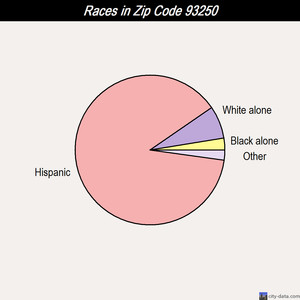
Across the US, 37.6 million of 314 million Americans speak Spanish; of these only 18 million were Spanish-only speakers. That’s only 11.9% and 5.7%. By contrast, in McFarland, 84.2% speak Spanish at home. (Source: http://quickfacts.census.gov/qfd/states/06/0644826.html)
|
A significant portion of Spanish speakers in McFarland are believed to be in this country illegally. “Undocumenteds” are likely to be underreported in census data, so the figures above are likely to be underestimates.
The question for COTLS is: how do these figures affect the church’s ministry and outlook? The short answer is: dramatically.
Short and Long Term Prospects
In the short term, the church has a series of crucial decisions to make on its overall stance toward the ethnic complexion of the area.
Options
- One option is to make an intentional decision to be an English/Anglo church. This is not as foolish as it sounds; after all, African-American churches often thrive in predominantly white communities. However, this turns the reach of the church from being over a community of 12,000 to a village of perhaps 1,000. To intentionally limit the church’s reach would seem to be an action of poor stewardship of resources.
- Another option is to develop a “Hispanic department.” Usually this is done by creating class or subgroup of the church that uses Spanish in its communications. This requires a key person or couple—almost certainly Hispanics—to act as the anchors of the department; this also requires a significant time contribution.
- Another is to host a Hispanic “nested church” with interlocking ministries. This would be an existing church seeking a location in which to meet. There must be both a theologically compatible church, with leadership that has an open and cooperative attitude. In particular, the pastor of the Hispanic churches needs to be able to successfully act as the face of his church vis-à-vis COTLS.
By “interlocking ministries”, I mean working together on VBS or sidewalk Sunday school (see under children’s ministry), Sunday school, youth ministry and perhaps worship leadership. Other interlocking ministries may include ESL (English as a Second Language), US Citizenship Preparation Classes, etc.
The Sunday schedule could be used to accommodate the nested church: ex., Hispanic church at 8:30 AM, Sunday school at 9:45, COTLS worship at 11:00 AM. Key celebrations (ex., Christmas Eve) are held jointly.
It is understood that COTLS did this before with La Mision de Jesus. That was not a failure; it was a success that exceeded expectations. A new and vital church was born. They key is finding a more theologically and stylistically compatible church.
- A bolder approach to be move toward being a fully united Anglo/Hispanic church. A good model for this is nearby at the First Baptist Church of Yakima, Washington, which is known on the Hispanic side as Comunidad Christiana (see www.fbcyakima.org). This is similar to the nested church except that the Hispanic congregation is fully a part of the church.
- Bilingual church: this is the hardest model, in which there is a single congregation with various means of interpretation for worship services and other events.
- Yet another approach--one that, by the way could be done simultaneously with option 3, is to position the church as the evangelical church in that area that is (a) English speaking and that is (b) aimed at the “Sal and Sandy” population--people that live on the border between cultures.
In the long term, it is likely that McFarland will become even more ethnically Hispanic. More Hispanics will become documented, more will become primary English-speakers and they will move into the middle class. Since the birth rate is falling in Mexico and since greater efforts are being made to secure the US-Mexico border, we can expect stabilization of the Hispanic population in the US within 20 years. By that time, McFarland will be almost entirely Hispanic, but also more Americanized, English-speaking and somewhat more middle-class. In other words, there will be a lot more Sal and Sandys as time goes on.
Discipleship
Adult Discipleship
It is striking that Jesus commanded us to “make disciples”, not to conduct worship services (Matthew 28:18-20)! This is the inescapable mission of the church: to make disciples. What is negotiable is how discipleship is delivered. The “delivery system” of adult discipleship is open for discussion.
Sunday School
Sunday school is a time-honored spiritual formation delivery system, but there are significant problems with relying on it as the prime delivery system at COTLS. First, while those raised in Sunday school find it a source of spiritual growth, many younger adults are ducks out of water in a Sunday school class. Second, if the church ramps up children’s ministry up as described earlier, younger adults are going to be needed to conduct children’s ministry--and people can’t be in two places at the same time.
So what’s to be done? Again, this is a dramatic departure, but here it is: don’t worry about getting young adults in Sunday school. Instead, steer our few young adults toward working with children’s ministry. First, we need the workers. Second, remember what we discussed about how ministry gets mingled with discipleship--you learn what you need to learn when you’re thrown into the mix. Third, guys are needed to run the more physically active parts of children’s ministry. Finally, this approach to children’s ministry is designed to involved parents with what their kids are learning. 252 Basics have materials that are designed to go into the hands of parents to reinforce the lessons that the the children get.
Obviously, that’s not enough to make fully formed disciples. One approach is to devote a significant portion of children’s team meetings to spiritual growth issues--and to have frequent meetings. For example, what if team members met over dinner at the church each Wednesday at 6 PM, with dinner prepared by more senior members, who then watched the kids of team members while they met from 6:30 till 7:30?
At some point in the future, when there are plenty of children’s ministry workers, adult discipleship should be revisited to consider adding either Sunday morning or mid-week growth groups.
Space Ratios
Space ratios are helpful to examine as decisions are made regarding where to invest in the appropriate disciples delivery systems. At COTLS:
- A 70% full sanctuary holds 90 people (does not count front pew or balcony)
- A 70% full adult study space holds about 70 people.
- A 70% full parking holds 111 people (65 cars averaging 1.7 people per car) (As an aside, guest parking spaces ought to marked.)
The significance of 70% is that at that level a room feels full. (This percentage, by the way, has dropped in the last 25 years, which means that the average American has a lower tolerance for close spaces today than he did in 1980. Retail stores and restaurants have closely researched this trend. Interestingly, spaces with theater seating--movie theaters and sports stadiums--are largely unaffected by these trends because of the way those seats clearly define personal space.)
For the present, there is adequate space for worship, education and parking. This will have to be reassessed when worship reached 90 on a regular basis.
The Saddleback Diamond
The Saddleback Diamond (see page 7) has also been developed into a pathway of discipleship. Saddleback Church—as well as thousands of churches around the world—offers a core curriculum of free-standing seminars:
101 CLASS (Christian Life and Service Level Seminar): To lead people to Christ and membership
201 CLASS: To grow people to spiritual maturity
301 CLASS: To equip people with the skills they need for ministry
401 CLASS: To enlist people to the worldwide mission of Sharing Christ
These seminars should be offered in the following manner:
101: 9-10 times per year
201: 4-5 times per year
301: 2-3 times per year
401: 1-2 times per year
All seminar materials have been left on the pastor’s computer. They have been modified for use at COTLS.
EVERYBODY starting with board members should be encouraged to work through the Diamond Seminars.
Prayer
Recalling the Four Pillars, remember the second pillar--right devotion. I suggest regular meetings for prayer. Specifically, prayer should be incorporated into all regular meetings and I would add quarterly special days for prayer. Days of prayer should especially precede Big Days (see under evangelism). 2-3 Saturday prayer breakfasts annually can be part of the prayer emphasis.
Men’s and Women’s Groups
In churches the size of COTLS, it’s best to do men’s and women’s ministries through a combination of small groups offered and an annual retreat. I would suggest nothing more complicated than that.
Leadership Development
For leader development, I make the following observations:
First, it is very wise that leader development is repeatedly emphasized in the current COTLS Bylaws.
Second, all officers and teachers of the church should be required to attend the 101-401 seminars.
Third, an annual two-hour board training seminar should be developed for all existing, prospective and new board members. This should focus on three areas: (1) the Biblical teaching on elders and their functions, (2) characteristics of Biblical leadership and (3) practical application: the elder board, the teams and the congregation; the elders and the pastor. (I have written material specifically for elder training which is available upon request.)
Fourth, there are wonderful resources for the development of new leaders, such as Leadership Essentials by Greg Ogden. Tom Bundy suggests the standard that each member of the church board have someone that they are either discipling or mentoring for leadership. (His website, www.thrivingchurch.com, is full of helpful resources.)
Stewardship as Discipleship
Never forget that stewardship is not simply as a means of financing the church. It is first and foremost a form of and a measure of spiritual maturity—it is a discipleship issue.
Household income data: $35,812; for California, $61,400; for the US: $51,000.
Here are the vital statistics on COTLS stewardship:
- McFarland’s Median Household Income: $35,812
- Church Households: 32 (that is, giving unit households)
- Income as a Congregation: $1,145,984
- Congregational Tithe: $114,598
- 2013 Contribution Income: $131,220
- Giving as a Percentage: 11.45%
- National average for Protestant churches is approximately 2.8%
A few points:
- I initially was astonished by these figures. Then I discovered that a few donors were giving far in excess of a tithe, something to thank God for daily!
- The following is an educated guess, but if that extraordinary gift is taken down to a tithe, income would be in the $90,000 area. That would make the contribution level of the church about 7.5%.
- COTLS can take heart in the fact that church giving is nearly three times the national average for Protestant churches.
- Nevertheless, there remains a growth challenge for the church’s giving. The church is being carried by a few givers, and no source of giving lasts forever.
- Processes are available from to boost good stewardship. I reccomend Nelson Searcy’s Maximize; I highly recommend that this be repeatedly revisited to grow the church’s stewardship.
- Above all else, good solid Biblical teaching on stewardship is needed. Most poor giving by believers comes from ignorance, followed (sadly) by indebtedness and (even more sadly) greed.
Fellowship
Existing Strengths
Care
On the survey, COTLS scores well as a caring community. Small Churches tend to score well in this regard, as this church does.
Sense of Community
COTLS also has a strong sense of community; that is, not merely care, but of being one body pulling in the same direction. This is one of the supreme signs of church health (see John 17:22-23; 1 Corinthians 3:1-4; Philippians 2:1-2; Ephesians 4:1-6; Colossians 3:12-15, etc.)
The Family Principle
A sense of family is created by two things (1) family traditions and (2) enduring hardship together. While you cannot “program” the second, you can the first. A good principle is to average about one shared experience every two months. That being said, the church may want to consider diversifying the nature of their fellowship events. For example, outings as a church can be a great unifying experience--such as an annual trip to see a professional baseball game. Another is an annual picnic at a park. Public places are to be preferred to private for the witness value they have. Do not hold all fellowship events either at a members’ home or on the church property.
Results of the Survey and Study Done by Mark Lambert of Transformation Ministries
In March and April, 2014, in conjunction with the transitional services contracted by the church with Transformation Ministries of Covina, California, a survey of the congregation was conducted and a report issued by Rev. Mark Lambert.
In the survey, church members and leaders were asked to respond to a series of questions related to the church’s health and ministry. Ten marks of health were graded. The three charts below sum up the responses:
Raw Rankings. All responses are on a scale of 1 (low) to 5 (high)
Survey Order
| ||
Love
|
1
|
3.534
|
Bible
|
2
|
4.227
|
Outward
|
3
|
2.417
|
Worship
|
4
|
3.747
|
Disciple
|
5
|
2.081
|
Unity
|
6
|
3.081
|
Serving
|
7
|
2.866
|
Govern
|
8
|
2.770
|
Humility
|
9
|
3.047
|
Partner
|
10
|
3.277
|
Average
|
3.104
|
Priority Ranking by Scores
Bible
|
1
|
4.226
|
Worship
|
2
|
3.747
|
Love
|
3
|
3.534
|
Partnership
|
4
|
3.277
|
Unity
|
5
|
3.081
|
Humility
|
6
|
3.041
|
Serving
|
7
|
2.866
|
Govern
|
8
|
2.770
|
Outward
|
9
|
2.417
|
Disciple
|
10
|
2.081
|
Average
|
3.104
|
Ranking by the Most Unknowns – usually an indicator of needing attention (high uncertainty)
Discipleship
|
1
|
29
|
Partnership
|
2
|
26
|
Serving
|
3
|
23
|
Humility
|
4
|
19
|
Govern
|
5
|
18
|
Unity
|
6
|
11
|
Outward
|
7
|
11
|
Love
|
8
|
7
|
Bible
|
9
|
6
|
Worship
|
10
|
4
|
Total
|
154
| |
Because the ten areas are ranked and we also measure the answers not given, we are able to both measure perceived areas of strength and weakness as well as areas of high uncertainty. In other words, we learn a lot about the church not only in the answers but also where no answers are given. In broad terms, the church feels fairly well about commitment to the Bible, worship, loving one another, unity and humility one to another. It does not feel well about church governance, being outwardly oriented and discipleship.
The highest unknowns show us that there is confusion about discipleship, partnership and church governance. “Without a vision, the people perish [are unrestrained, lack direction]” (Proverbs 28:19). This is evidence of the widely perceived sense of a lack of pastoral leadership.
An aside: some might ask if a board can provide leadership. The short answer is no. Individuals lead; boards govern. Leadership comes from character, skills and calling. The mixture of callings and personalities in a board tend to cancel out one another. A good leader leads as part of a team, deeply enmeshed in the fellowship of a leading team, but never simply representing the team. The leader goes beyond the team not because he is better, or smarter or more spiritual, but simply because that’s what he’s been called to do.
Comments--titled “Breakout Questions”--gathered comments that pulled in two distinct directions. Some pull backward: “Sing more hymns...include the Lord’s Prayer in worship...select an anabaptist pastor.” By that, what’s desired is the restoration of a past that is likely not recoverable. These comments are not bitter or poorly-intended: the reality is that most people simply cannot see what they have not experienced. Hymn-singing, traditional elements, etc., may make the existing congregation happy, but they don’t help us accomplish mission. Mission accomplishment is always to be preferred to membership happiness, and unfortunately, these two are rarely compatible.
Some pull forward: “modernize our plant, worship and ministry...invite someone from the community...be more intentional and consistent in our outreach to our neighbors...focus on the future not the past...we need to make drastic changes if we are going to grow...don’t dwell on our past ‘glory’.”
One of the key characteristics of leadership is not merely to poll the group, and do what they say, but to enfold their needs into a larger framework that takes the group beyond their concerns toward a preferred future, and which understands the strategic order in which things need to be done.
That being said, what we discern from the surveys and what we’ve seen by other means elsewhere can be summed up in six observations.
1. Clarify Mission, Vision, Values and the Disciple’s Pathway
Clarity is essential for a healthy church. Yet it’s amazing how many churches seem to have poorly defined missions. The main mission of something like 80% of churches in the US seems to be survival. Ironically, that purpose is the very one that will most likely lead to death.
Mission is the overall reason the church exists. This is a matter that is not up for debate: Jesus gave the church’s mission in Matthew 28:20: make disciples. He never said, “Go forth and conduct worship services” or “Go forth and make sure my church survives.” Make disciples!
Vision asks--what’s the purpose of this church? Why did God call forth this church, in this place and time, to exist?
Values asks the question--what’s important to us as a church? That’s shaped by both mission and vision. Values should not only be current values, but aspirational values. Sometimes a church will simply state where they are with their values; these values represent what we truly value even if we’re not yet fully living out those values.
Mission, vision and values should live in dynamic interaction with the church’s statement of faith. That is, if we really believe these things, here are the mission, vision and values that ought to result.
I have supplied a model of Mission/Vision/Values in an appendix to this report.
There also needs to be clarity when it comes to making disciples--I call this the Disciple’s Pathway. Again, many churches rely on spiritual formation by accident. The result is haphazard at best. A successful disciple’s pathway will have the following elements: simplicity (it can be easily explained and understood), direction (it moves disciples forward in worship, growth, ministry and outreach) and flexibility (it has elements that can be altered to fit specific needs).
What I have found helpful in defining the disciple’s pathway is defining a core with the Saddleback CLASS: Christian Life and Service Seminars. (101: Discover Membership, 201: Discover Maturity, 301: Discover Your Ministry and 401: Discover Your Mission, discussed elsewhere in this study.) Branching out from the core are elective small growth groups. These growth groups adopt or engage in both a ministry (inside the church) and an outreach (outside the church) for each time segment they meet for (roughly a three month period). Small groups can also be formed from task to group--like a growth group for children’s ministry workers.
All leaders should be required to work through 101-401, be in a growth group (whether it means on Sunday morning or during the week) and, at the board level, be engaged in discipling or mentoring someone else.
2. Overhaul and Simplify Church Governance
Simple Church shows the way: the most effective churches keep things simple. That includes church governance, which is discussed elsewhere in this study. I highly recommended Winning on Purpose by John Kaiser as the roadmap. I have included a summary and some key charts from his book in an appendix.
3. Cast a Net of Partnerships
Survey results show both that few know about partnerships forged from the church to the community and to the larger world. A conscious effort should be made to both forge such partnerships within and beyond the Church of the Brethren, missions organizations as well as with local and regional organizations and to publicise those connections.
4. Focus on Children’s Ministry as the Catalyst for Outreach and Discipleship
This is elaborated on elsewhere in this report, but suffice it to say that so many things depend on excelling in this area.
5. Celebrate and then Sunset That Which is No Longer Effective
People only have so much time and energy. As time goes on, some things will be identified as no longer effective. When something is sunsetted--a principle the current church bylaws identifies--it should be celebrated for its past value and then given a well-deserved conclusion. For example, when the current children’s Sunday school is transformed, the years of effective age-graded, classroom oriented Sunday school should be celebrated.
A Few More Thoughts
On Mission, Vision and Strategy
This is a critical time to revisit mission, vision and strategy. Most of this paper is devoted to strategy, but a few comments are in order on the broader issues.
Mission
“Make disciples” is the essence of the mission of the church as given by Jesus (Matthew 28:18-20). It can be truly said that this is central and non-negotiable. When churches do not make this the center of their mission, they only suffer as a result.
Vision
Vision speaks to a different issue than mission: while “make disciples” is universal, vision is local. What is unique about the call of God to this church in this place? This should be carefully and prayerfully developed, because when followed, this becomes the guide to the specific decision-making and programming of the church.
Strategy
Strategy is then developed that assists the church carry out the mission and the vision.
To understand how this works, let’s take an example from US history: the Pacific theater of the Second World War.
Mission: To defeat the Japanese Empire
Vision: We will defeat Japan by forcing them out of conquered territories, taking control of major shipping lanes in the Pacific, and ultimately waging war on Japan until their ability and will to fight has ceased.
Strategy: US and allies forces will move from east to west across the Pacific in three main thrusts: northern, middle and southern. We will seize strategic islands and defeat fleets which have the ability to break out of a tightening cordon. We will selectively bypass locations lacking strategic significance, isolate the Japanese homeland until they surrender and/or we invade Japan to secure their defeat.
Mission, in this case is non-negotiable; vision is broad but is specific to the time and place (how different would this be if such a war had taken place in 1900, not 1941-1945?), and strategy is even more specific and more transitory. Mission doesn’t change; vision changes slowly; strategy changes quickly.
Church Motto
I further suggest that a motto be developed which expresses the essence of the mission and vision in a few words. When I was in Temple City, CA, after going through the process above, we came up with “Loving God, Serving People.” Here are some other examples:
“More and better disciples of Jesus”(Timberlake Church, Redmond, WA)
“More people like Jesus” (Eagle Rock Baptist Church, Los Angeles, CA)
“Love, Grow, Serve, Go” (Springfield Baptist Church, Springfield, KY)
“Making, Molding and Mobilizing Disciples” (Pacific Baptist Church, Pacific Palisades, CA)
Name of the Church
I briefly discussed the name of the church under discipleship. Some more thoughts as it relates to mission, vision and values.
Another angle on the question of name change should be broached only after (or during) the mission/vision process. Any new name should be united to the new mission/vision.
Any name change should be part of enhancing the ability of the church to achieve its mission/vision. For example, if it can be demonstrated that there is a negative reaction to the name “Brethren”, that’s a good reason to change the name. A friend who was planting a church in La Canada-Flintridge, CA discovered there that the name “Baptist” was perceived very negatively in that upscale community.
Also, effort should be made to gage the cache of the name “Brethren” among local Hispanics. In the church I last served, we discovered that denominational names were perceived positively by Asians, and that was one factor in not changing the name of the church.
Governance Issues
Concern about church governance has been expressed to me. So many of the issues revolve around pastors who did not or chose not to exercise responsible leadership. But that in turn comes from a root concern of both pastors and churches: who’s leading? And who--to put it bluntly--gets in trouble when things go wrong?
In addition, I have heard concern about the elimination of the office of deacon when the church revised its constitution in 1987. Deacons have special historic importance for Brethren churches in their annual visits to church members to enquire on their spiritual well-being in preparation for the Love Feast.
I believe a path forward for COTLS can be found in what I call the Team Based Church. This is what I call the model that is described in great (but accessible) detail in John Kaiser’s book Winning on Purpose (Nashville: Abingdon, 2006).
As Kaiser says, the essential unit of ministry shifts from the pastor and the board, and the congregation “plays ministry.” That’s why I like to call this the “team based church” because that’s the ultimate desired outcome. The church is released to focus on ministry that blesses both the congregation and gives them leverage to change their world.
The pastor “plays leadership.” Strong pastors energize and empower the whole church. This must be rooted in the character of the pastor so as not to degenerate into authoritarianism. He inspires the board, directs the staff and teaches the congregation.
The board “plays governance.” Governance is not leadership, management or ministry. It is accountability and support. The board governs, representing Christ, the true owner of the church, and working from the church’s mission, develops guiding principles, holds the pastor accountable for effectiveness and supports the pastor as he carries out the decisions that are within the guidelines and help accomplish mission.
Finally, the staff “plays management.” Staff is defined as the pastor’s team to carry out ministry, whether paid or not. They lead or administer team ministry to carry out mission.
The model is largely taken from the work of John Carver, which was developed for all sorts of non-profit organizations (see http://www.carvergovernance.com/index.html). Many existing and virtually all new churches are adopting some variant of the Carver model.
Here are essential elements to understand the new model:
- The pastor is seen as the CEO of the organization. He has been given considerably more authority that traditionally granted by congregational churches. He sets a budget (in consultation with the board) which then goes to the church for approval. He has hire/fire authority. He can make budgeted purchases. He can initiate programming which helps to fulfill the mission/vision of the church. He has complete authority over all (ministry and support) staff. He does performance reviews of staff. It is essential to understand that staff is not supervised by the board or by teams, but by the pastor.
- The board are the only elected officers. The pastor and elders serve side by side, the pastor regarded as one of the members of the board, expect of course for matters of supervision of the pastor.
- The board’s role is to set or finalize the mission/vision (in close cooperation with the pastor). These are called “mission principles.” They also define what may not be done (“boundary principles”).
- Ministry is largely carried out by ministry teams. They are not defined in the church bylaws, on purpose. The board simply assist the teams to organize. The board may call a new team(s) into existence, may dissolve a team, and may remove a member from a team. A Biblical precedent for this can be found in the Hellenist care team established by the apostles (Acts 6:1-6).
- Team members are not supervisors of others. They are the people actually doing the ministry. For example, the people on children’s ministry are the people actually doing the ministry, not someone else telling them what to do. That’s an unneeded and unwanted layer of bureaucracy.
On deacons, I would suggest that the office of deacon be reinstated. I would add this observation: going forward, all board members should be required to serve as deacons first, for at least a year. The reason for this is not because the office of deacon is lesser than that of elder or overseer--it’s because it’s a good role of service and people-care to prepare a person to serve in a more supervisory capacity. A heart to serve should be demonstrated before a heart to lead.
Making such a dramatic change of governance is likely to create some confusion or uncertainty at times. Patience and grace is the proper response.
The Next Pastor
Some thoughts to consider as the church considers the next pastor‘s leadership.
Characteristics
McFarland presents a challenging environment for ministry. It requires a high-energy response and a self-starter to lead. It will also require a continuous self-learner.
Skills
Apart from the universally desired pastoral skills (personal touch, preaching, etc.), I would suggest that skills in multicultural communication and organizational skills will be important. Ability to speak fluent Spanish would be a huge plus.
Systems
Mastery of the four pillars and of the systems approach would also be highly desirable. Joining the next available round of the CLI coaching network is the single best way to achieve that mastery.
Regarding the systems approach, here’s some background. A few years ago, I began getting emails from a pastor in New York City named Nelson Searcy. Eventually, I followed the links to his website, Church Leader Insights. I was impressed by his way of thinking and also the practical insights he had and in 2008-2009, I became part of his coaching network. In 2009, our church even hosted a small group workshop conducted by Nelson’s associate, Kerrick Thomas.
Nelson urges churches to think in terms of eight systems that constitute the “best practices” needed to move the church forward.
System #2: "The Evangelism System"*
System #3: "The Assimilation System"*
System #4: “The Small Group System”*
System #5: "The Ministry System"
System #6: "The Stewardship System"*
System #7: "The Leadership System"
System #8: "The Strategic System"
I’ve found this approach to be extremely helpful in evaluating and improving the church’s ministry. In addition, we saw immediate spikes in attendance as we applied the assimilation system, immediate spikes in giving as we applied the stewardship system and lesser but undeniable improvements as we applied the other systems.
The “systems” can’t be relied on to do everything. But they are a great way to accelerate the overall practices of the church.
Also, I have developed my own Missions Promotion system which is included in the data on the pastor’s computer.
Action Plan for Church of the Living Savior
This is the most important part of this study. This is where “golden dreams” take “wooden steps” into realization.
This timeline is done by season rather than by date. An item not accomplished in one season will need to be done the next, but moving a substantial item more than one season will seriously jeopardize the whole plan.
Late Spring-Summer 2014
- Present this study to the church board
- Present this study to the congregation
- Update church signage (inside and out)
- Launch a new church website
- Fully implement the Saddleback Diamond as the backbone of the disciples’ pathway
- Update space used for children’s ministry
- Hold a prayer breakfast a week before VBS
- Hold VBS as part of a transformation of children’s ministry
- Form children’s ministry team that plans to stay together for at least a year
- Hold a follow-up children’s ministry picnic about a week before school begins
- Address and determine the worship and class time
- Mount projector in worship center and train new workers to run projection
Fall 2014
- Overhaul church governance with a new set of bylaws
- Board to deal with a new statement of mission, vision and values, and name of church and a plan to keep the MVV before the church
- Start using testimonies in worship on a regular basis
- Launch “Adventureland” children’s ministry
- Launch mid-week growth group for “Adventureland” workers
- Form partnerships with Chamber of Commerce, local schools, support groups and possibly an Hispanic congregation seeking a meeting site
- “Back to Church” Sunday picnic
- Begin to have children do special event things (sing, etc.) in worship
- Harvest party
- Thanksgiving Dinner (celebrate victories thus far)
Winter 2014-2015
- “Birthday Party for Jesus” (children’s ministry)
- Identify the “heart of darkness” of the community that the church can address
- Identify appropriate servant ministry opportunities
- Implement leader development plan
Spring 2015
- Call a new pastor
- Familiarize new pastor with this report and actions subsequently taken
- Consider adding more adult growth groups
- Training church members in sharing their faith
- Hold a “Big Day” before Easter, then treat Easter as a “Big Day”
Appendices
Appendix One: The Four Pillars of Ministry
The following is taken from a class I taught at California State Christian University in the fall of 2011. It is in group presentation form.
The Four Pillars of Ministry
Some Key Assumptions
• You are interested in growing as a leader.
• Church Leadership is the highest level of leadership.
• You are active in leadership development already.
Three Starting Principles of Leadership
Principle #1: Leadership is influence.
Principle #2: Leadership determines outcome.
Principle #3: Leadership requires followers.
What is the objective of pastoral leadership?
Matthew 28:18-20
18 Then Jesus came to them and said, “All authority in heaven and on earth has been given to me. 19 Therefore go and make disciples of all nations, baptizing them in the name of the Father and of the Son and of the Holy Spirit, 20 and teaching them to obey everything I have commanded you. And surely I am with you always, to the very end of the age.”
What does mature discipleship look like?
- Knowledge of Scripture and basic theology
Example: Who wrote Romans? What is the Trinity? Where can I find the 10 commandments? How many gospels are there?
Theme verse: “Let me understand the teaching of your precepts; then I will meditate on your wonders.” (Psalm 119:27, NIV)
- Perspective on life solidly based on Scripture
Example: How do I resist temptation? How does the Bible speak to the issue of same-sex marriage? How do I face the reality of death?
Theme verse: “My mouth will speak words of wisdom; the utterance from my heart will give understanding.” (Psalm 49:3, NIV)
- Conviction that secures passionate loyalty to God and His kingdom
Example: I would die for my faith. I will give the tithe and beyond for the sake of the kingdom.
Theme verse: “For to me, to live is Christ and to die is gain.” (Philippians 1:21, NIV)
- Skills which enable disciples to effectively serve
Example: I know how to study the Bible for myself. I know how to share my faith. I know how to serve joyfully in a specific ministry.
Theme passage: “And David shepherded them with integrity of heart; with skillful hands he led them.” (Psalm 78:72, NIV)
- Character which reflects the character of Jesus Christ
Example: I am growing in love for my church family and for lost people.
Theme passage: “The purpose of my instruction is that all believers would be filled with love that comes from a pure heart, a clear conscience, and genuine faith.” (1 Timothy 1:5, NLT)
The Four Pillars of Pastoral Ministry/Arenas of Leadership
The Four Pillars are a way of thinking about church ministry and pastoral leadership. Like a great building, the four pillars must be equal at the four corners of the church. However, there is a logical progression, moving from the knowledge of God to human relationships and activities.
The First Pillar: Right Faith
Sound doctrine, based on Scripture, centered on Christ, certain and settled on all essential truths of the faith. The starting place is always God. He wants us to know Him rightly. Doctrine matters because doctrine is all about who God is, what He is like, what He does and what He commands us to do.
Are you well grounded in Scripture? Are you constant in your study of Scripture? Is your understanding of what we believe and why we believe it growing?
Church role: learning disciples.
Pastoral leadership role: chief theologian in residence.
What is your strategy to keep growing as a student of the Scriptures and of sound theology? What’s your Bible reading plan? How are you growing in your understanding of theology?
The Second Pillar: Right Devotion
Passionate worship and personal devotion to God expressed in corporate worship, attention to Scripture, daily prayer and commitment to continuous spiritual growth. God calls us to have more than right faith. He wants us to have a vital, passionate relationship with Him. Pharisees knew plenty of doctrine, and it was 90% correct, but Jesus said their hearts were far from God.
What’s your spiritual temperature? What’s your quiet time with God like? Are you able to worship with passion and abandon? Are you closer to God today than you were this time last year?
Church role: holistic worshippers.
Pastoral leadership role: spiritual mentor.
What is your strategy to keep growing in your personal time spent with God that deepens your walk with God, deepens your prayer life and that gives you the opportunity to teach and lead by example this life to others?
The Third Pillar: Right Relationships
Speaking the truth in love, compassionate, kind, humble, gentle and patient; generous in forgiveness, brimming over in love. We turn that same commitment to love God toward one another. Jesus said that our love for one another would be the evidence to the world that we are His disciples.
Steve Robbins (www.robbinsnestministries.org) once did a survey at a church conference asking the question, “What’s holding your church back from its potential?” His discovery: BMWs! By that he meant “busyness, meanness and worldliness.” All these are relationship killers: when we’re too busy to develop and cultivate relationships, when we are downright mean and rude to one another, and when are allow the world to contaminate our hearts.
How high up are relationships in the body of Christ on your priorities? While all your efforts may not be reciprocated, are you making an effort to develop, deepen, and repair relationships?
Church role: koinonia (fellowship, mutually dependent) body of Christ
Pastoral leadership role: shepherd of the flock.
How do you stay aware of personal needs of the flock? Do you have a systematic way of staying in touch of these needs? How much time do you spend with your people? And how engaged are your when you are with them?
The Fourth Pillar: Right Practices
The application of the best practices in administration, ministry and outreach throughout the ministry of the church. Most of us have heard the term “best practices” from our workplace. There are “best practices” when it comes to ministry as well: there’s a right way to evangelize, to connect people, to disciple people, to encourage stewardship, and so forth. But “right practices” come last. You can’t lead with best practices unless right faith, right devotion and right relationships are in place.
Are you striving to do what you do better than you’ve done it before? Are you striving to be a learner, a grower and goer than strives to do your “utmost for His highness”? Do you seek out opportunities to grow in service?
The church is made up of people. In 1 Peter 2:5, Peter says that we are “living stones…being built into a spiritual house.” (Paul says much the same thing in Ephesians 2:19-22). How balanced are you as a stone in the house of God? Where do you need to grow and change? Which corner—faith, devotion, relationships and practices—needs to be shored up? Are you willing to work on it?
Church role: missional (having a kingdom assignment that changes their world) body.
Pastoral leadership role: innovative church manager.
Are you engaged in a systematic process of identifying your church systems, bringing them up to the next level, and then reviewing these processes on a regular basis to improve them? What’s your personal plan that bridges over to your church plan?
Appendix Two: The Five Purposes of the Church
The Purpose Driven Model
Glenn Layne
In recent years, I have adopted the “purpose driven” model that has become well-known through in the ministry of Rick Warren of Saddleback Church in Lake Forest, California. All churches are “driven” by something—tradition, denominations, the perceived needs of the members, even the desire to appeal to the surrounding community. The purpose driven model asks, “What were the priorities of Jesus?” Instead of starting by asking what you or I or other people think, what were the driving purposes of Jesus?
By examining the Great Commandment (Matthew 22:36-40 and parallels) and the Great Commission (Matthew 24:19-20), five purposes emerge:
1. “Love God with all your heart” = WORSHIP
2. “Love your neighbor as yourself” = MINISTRY
3. “Go...make disciples” = EVANGELISM
4. “Baptizing them” = FELLOWSHIP
5. “Teaching them to do” = DISCIPLESHIP
Other passages confirm this five-fold pattern. My experience is that if you gather a group of Christians together and ask them what the purposes of Jesus are for His church, the group will usually come up with four out of five of these (and the one left out is not always the same). If you suggest the fifth item, the response is usually, “Yes, we should add that one too.”
Tom Mercer from High Desert Church in Victorville, CA adds a good point: there’s only one of the five that I can only do now, here on earth: evangelism. It’s the priority purpose for life on earth.
Numerous Biblical passages confirm the fivefold purpose of the church:
Jesus’ ministry modeled these five purposes in John 17:1-26; the first church fulfilled these five purposes in Acts 2:41-47; Paul explained these five purposes Ephesians 4:11-16.
In addition, Purpose Driven is easily explained and lends itself to easy visual representation, such as the famous Saddleback baseball diamond:

PD encourages sequential thinking. Church is going somewhere: there is the conviction that God’s desire is to move people forward from conversion, to fellowship and discipleship, to service/ministry (inside the church) and mission/evangelism (outside the church).

Appendix Three: Eight Systems of the Church
Church Systems
Glenn Layne
A few years ago, I began getting emails from a pastor in New York City named Nelson Searcy. Eventually, I followed the links to his website, Church Leader Insights. I was impressed by his way of thinking and also the practical insights he had and in 2008-2009, I became part of his coaching network. In 2009, our church even hosted a small group workshop conducted by Nelson’s associate, Kerrick Thomas.
Nelson urges churches to think in terms of eight systems that constitute the “best practices” needed to move the church forward. These are all in the area that I call the Fourth Pillar of Ministry (see my article in the Occasional Writings section):
System #1: "The Weekend Service System"
System #2: "The Evangelism System"
System #3: "The Assimilation System"
System #4: “The Small Group System”
System #5: "The Ministry System"
System #6: "The Stewardship System"
System #7: "The Leadership System"
System #8: "The Strategic System"
I’ve found this approach to be extremely helpful in evaluating and improving the church’s ministry. In addition, we saw immediate spikes in attendance as we applied the assimilation system, immediate spikes in giving as we applied the stewardship system and lesser but undeniable improvements as we applied the other systems.
The “systems” can’t be relied on to do everything. But they are a great way to accelerate the overall practices of the church.
Appendix Four: Servant Evangelism
What is Servant Evangelism?
One church, one summer: they enlisted 15-20 people a week to do servant evangelism for two hours a week.
The result: a 100% increase in attendance that summer!
A definition of servant evangelism
Doing intentional acts of kindness with the express purpose of sharing Jesus
Service + evangelism
Why it works
- It’s Biblical (Mark 10:45). Love neighbors, reach the world.
- It’s surprising. Why are you doing this? Breaks down barriers.
- It’s easy. Carry out great commandment, great commission. Anybody can do this.
- It’s fun. Teamwork is fun; doing God’s will is fun. You’re making a difference.
- It’s contagious. A good first step toward an evangelistic lifestyle.
Some examples
- Hold a free car wash. (Really free)
- Free water on a hot day.
- Gums at a park
- Wash car windshields/ leave a note
- Find ways to beautify the community
- Free oil/tire checks
- Pay for wash at laundry mat
- Pay a toll behind you
- Free light bulbs (light of Jesus)
- Return carts at a mall/market
To do a project
- You need a good idea
- Secure the materials you need
- Info about the church
- A place to do the project
- Willing servants
Finding servants
- Start with you and a friend
- Enlist a class, youth group
- Bring them to a servant evangelism event
- Teach on it, then do it
Five principles for effective servant evangelism
- It starts with you
- It’s about sowing seeds
- Must be totally free
- Prayer—soak the project in prayer (maybe even some prayer walkers)
- Exponential thinking (keep the projects growing)
Two final thoughts
- At the end of each project, debrief
- And celebrate!
Appendix Five: A Model Statement of Mission, Vision and Values
Our Mission
Our mission is our general, unchanging reason for existing.
“Our mission is given to us by Jesus Himself in the Word of God: to make disciples of Christ from all nations, starting in our own area.”
Our Vision
Our vision or purpose is the specific task that we believe God would have us fulfill in this time and place through this church.
“This church is God's bridge which enables individuals and families of all faith and ethnic backgrounds from across the (AREA) to be drawn to Jesus Christ who transforms them in heart and deeds, from being unbelievers to active missionaries, so that year by year, we see more and more people who are more and more like Jesus.”
Motto
“More people like Jesus”
Our Values
Values are what X Church lives by to fulfill our purpose.
Love—Loving God Together through Worship Together
- We embrace the truth taught by Jesus that loving God is the first great commandment.
- X Church exists to love God and express that love through worship.
- Here, in every person and program, God is first, God is experienced and God is to be pleased.
- Worship is where the church puts on joy, enabling personal change from the outside in.
- We delight to constantly have God on our minds and in our conversations.
- X Church is the people and place where God is experienced. Public gathering to love God through worship is a primary expression. Personal worship and godly living is an equally important expression.
Grow—Growing as Followers of Jesus Together
- Christians are disciples—believers who are learning and changing to be more like Jesus. Continuing life change, also called spiritual formation, is the normal experience of growing Christians.
- Disciple-making is happening when we live like Jesus, especially under stress, and especially in demonstrating Christian love in relationships with others.
- X Church is a factory for spiritual formation or disciple-making—offering courses, networking relationships, providing community, showcasing examples, serving as a laboratory and offering a context for continuous disciple-making.
- X Church lives by the Bible. Spiritual growth apart from the Bible is not possible. Learning and living the Bible is natural and normal to X Church.
- Bible teaching permeates every program here because we want to know and understand God’s Word. The Bible must be lived out in our lives because we believe the Bible is God’s Word and the final word for what we believe and do.
- Discipleship or spiritual formation is where the church puts on muscle, enabling personal change from the inside out.
- We will continually change to get the job of spiritual growth done. We will include classes, seminars, retreats, mentoring, counseling and discipling. When appropriate, we will encourage Christians to take advantage of disciple-making opportunities at other churches or through other organizations.
Serve—Serving One Another and Serving Our Community Together
- We embrace the truth taught by Jesus that loving one another is the second great commandment.
- Service is a vital practice because it imitates Jesus’ own example.
- Christians are called to express their love for fellow-believers by serving one another.
- Service is where the church puts on humility and expresses love, enabling personal change from the outside in.
- Fellowship is a vital ingredient in spiritual growth, service and outreach. Fellowship is the environment that both enables growth and is the first arenas of service.
- All believers have been gifted by the Holy Spirit to serve in unique and valuable ways. We must yield to His work to be empowered by Him to serve.
- Christians are also called to express their love for the greater community by God-honoring service in the name of Jesus that uplifts and improves the community. This service is a vital part of our witness to the redeeming reality of Jesus Christ.
Go—Taking the Message of Jesus Christ to Our World Together
- X Church looks outward to serve non-Christians and the un-churched in order to reach them for Jesus Christ. This is woven into everything we do.
- Evangelism is where the church puts on speed, enabling personal change from the inside out.
- Outreach orientation requires awareness of our culture and connecting to people as they are and where they are. When a choice is made between serving needs of those on the inside or reaching out to others, we are committed in advance toward ministry to those outside. This is done to fulfill our purpose to make more disciples for Jesus Christ.
- We practice “go” in four dimensions of CARE:
City: the city of X
Area: the greater X area, focusing on the
Region: X State, the (Region) and the United States at large
Everywhere: all nations, especially where Christ is not known
Statement of Faith and Life Conduct
(This statement of faith was developed in conjunction with the above statement as an effort to forge a strong connection between doctrine and living.)
WE BELIEVE that the Bible is the fully inspired Word of God, inerrant in its original manuscripts. The Bible is our supreme and final authority in faith and life. (2 Timothy 3:16; II Peter 1:20, 21).
Therefore, we covenant to be students of the Bible, daily in the word, and to consult and obey Scripture in all matters of importance in our lives individually and together.
WE BELIEVE in one God, eternally existing in three persons; Father, Son, and Holy Spirit. (Genesis 1:1, 26; Matthew 28:19; John 1:1, 3; 4:24; Acts 5:3, 4; Romans 1:20; Ephesians 4:5, 6; 2 Corinthians 13:14)
Therefore, we covenant to be avid worshippers of the Triune God, together, alone, as families and in the conduct of our lives.
WE BELIEVE that Jesus Christ was conceived by the Holy Spirit, and born of the virgin Mary, and is true God and true man. (Matthew 1:18-25; Luke 1:26-38; Romans 9:5; Titus 2:13)
Therefore, we honor and worship Jesus Christ as God and Lord, Son of God, Savior of the world.
WE BELIEVE that man, male and female, was created in the image of God, that he sinned and thereby incurred not only physical death but also that spiritual death which is separation from God, and that all human beings are born with a sinful nature, and become guilty sinners in thought, word, and deed. (Genesis 1:26, 27; 3:1-24; Romans 3:25; 5:12-18; 1 John 1:8)
Therefore, we honor all people, of all races and nationalities, as bearers of God’s image, and we conduct our lives in humility, knowing that we are all sinners in need of God’s grace.
WE BELIEVE that the Lord Jesus died for our sins according to the scriptures as a representative and substitutionary sacrifice; that He rose victorious from the grave on the third day; and that all who believe in Him are justified on the ground of His shed blood. (Isaiah 53; Matthew 20:28; John 3:16; Romans 3:24-26; 5:1; 1 Corinthians 15:3; 2 Corinthians 5:21; Ephesians 1:7; 1 John 2:2; Matthew 28:6; Romans 10:9; and 1 Corinthians 15:14)
Therefore, we worship Jesus Christ, and we, with passionate urgency, share the greatness of Jesus will all persons. We regard the sacrifice and resurrection of Jesus as the great turning point of all time and eternity and the most important reality of our lives as well.
WE BELIEVE in the personal and imminent return of our Lord Jesus Christ. (Acts 1:11; 1 Thessalonians 4:16, 17)
Therefore, we live in expectation and service of Jesus Christ, and live this life with passion.
WE BELIEVE that all who come by grace through faith to accept the Lord Jesus Christ are born again of the Holy Spirit and thereby become children of God. (John 3:3, 5; 1:12, 13; James 1:18; 1 Peter 1:23; Ephesians 2:8, 9)
Therefore, we share Him with all, and regard one another in this church and in all of God’s faithful churches as brothers and sisters in Christ.
WE BELIEVE in the bodily resurrection of the just and the unjust, the everlasting joy of the saved and the everlasting conscious punishment of the lost. (John 5:28-29; 1 Corinthians 15; 2 Corinthians 5:10; Matthew 25:31-46; Revelation 20:4-6; 11-15)
Therefore, we regard the body as the precious creation of God and determine to live this life with the understanding that it is preparation for eternity.
WE BELIEVE that all Christians are baptized by the Holy Spirit when they are born again. We believe that water baptism by immersion is the biblical testimony of the professed believer in the name of the Father, Son, and Holy Spirit. (Acts 2:28-41,47; Matthew 28:18-20; Acts 8:36-40; 10:47; 18:8; Romans 6:3,4; I Corinthians 12:13)
Therefore, we determine to live in dependence on this of God for guidance, power, giftedness and godly character. Further, we practice believer baptism with great joy and celebration as the outward mark of New Covenant in Christ.
WE BELIEVE that those who partake of the Lord’s Supper should be born-again believers, walking in fellowship with the Lord Jesus Christ. (Acts 2:42-46; 1 Corinthians 11:23-29)
Therefore, we participate in the Lord’s Supper on a regular basis, looking back at the cross, reaffirming our covenant with Him and looking forward to His return.
WE BELIEVE that as Christians we are to meet together regularly for worship, ordinances, and the encouragement of each other. (Hebrews 10:24, 25; Acts 2:42, 46, 47a.)
Therefore, we covenant together to worship together unless traveling or unavoidably detained; further, we covenant our participation together in a small group for the purpose of spiritual growth, ministry and mission.
Appendix Six: Summary and Key Charts from John Kaiser’s Winning on Purpose
Summary of John Kaiser’s Winning on Purpose
(Nashville: Abingdon, 2006)
Part One: Do We Really Want to Win?
Chapter One: Playing to Win Beats Playing Around
The default setting of churches is self-service. Leadership moves the church from self-service to outward service.
Chapter Two: The First Step is to Stop Defeating Ourselves
Churches displace the Great Commission with good commissions, not evil commissions. But good is the enemy of great.
Chapter Three: The Basics Make a Game Worth Playing
The three basics are:
- The object of the game: the mission (mission principles)
- The rules of the game: sensible boundaries (boundary principles: theology, finances and ethics)
- How to keep score (team achievements that carry out the mission)
Part Two: Do We Understand the Game?
Chapter Four: The Object of the Game Defines Responsibility
Jesus’ Great Commission sets the “object of the game” for the church: make disciples
Chapter Five: The Rules of the Game Create Authority
Rules tell you how not the play the game. Anything inside the boundaries is fair game.
Chapter Six: Accountability is How We Keep Score
Boards, working from mission, create guiding principles as the means of carrying out mission. Pastor and staff are held accountable to achieve wins for mission within guiding principles without breaking boundary principles.
Part Three: Do We Know What Position to Play?
Chapter Seven: Ministry is a Team Sport
The team knows what winning means (make disciples, not happy members). Teams need a diversity of players and positions, competent captains as well as training and coaching.
Chapter Eight: The Congregation Plays Ministry
Trust is the essential intangible in successful churches. Both churches and pastors must decide between trust and control. This releases the church to focus on ministry that blesses both the congregation and gives them leverage to change their world.
Chapter Nine: The Pastor Plays Leadership
Strong pastors energize and empower the whole church. This must be rooted in character so as not to degenerate into authoritarianism. He inspires the board, directs the staff and teaches the congregation.
Chapter Ten: The Board Plays Governance
Governance is not leadership, management or ministry. It is accountability and support. The board, representing Christ, the true owner of the church, and working from the church’s mission, develops guiding principles, holds the pastor accountable for effectiveness and supports the pastor as he carries out the decisions that are within the guidelines and help accomplish mission.
Chapter Eleven: The Staff Plays Management
Staff is defined as the pastor’s team to carry out ministry, whether paid or not. They lead or administer team ministry to carry out mission.
Part Four: Do We Have the Right Equipment
Chapter Twelve: Organizational Documents Set Up the Game
Articles of Incorporation. Bylaws. Guiding Principle, which have three parts:
- Mission principles
- Boundary principles
- Accountability principles
Chapter Thirteen: Schedules Keeps the Game in Play
Quarterly board meetings, focused on governance, not administration. How to set up accountability style board meetings and how to transition to an accountability system.
Chapter Fourteen: Affiliations Relate the Team to its League
How the accountable church relates to denominations and how various polities intersect with the church.
Key Charts from Winning on Purpose by John Kaiser
Three Real World Structures of Church Government
Bureaucratic Structure
|
Authoritarian Structure
|
Accountable Structure
| |
Formula
|
Responsibility - Authority
|
Responsibility + Authority
|
Responsibility
+Authority
+Accountability
|
Result
|
= “Safe” but not effective
|
= “Effective” but not Safe
|
= Safe and Effective
|
Metaphor
|
Placebo
|
Narcotic
|
Medicine
|
Pastor as…
|
Employee
|
Dictator
|
Leader
|
Adapted from Winning on Purpose by John Kaiser (p. 71).
Telling the Players Apart in Winning on Purpose
Positions
|
Players
|
Functions
|
Metaphors
|
Ministry
|
Members
|
Outreach first, then care for one another
|
Teammates
Champions
Athletes
|
Management
|
Staff
|
Equipping and coordination
|
Assistant Coaches
Specialists
|
Leadership
|
Pastor
|
Vision, direction and teaching
|
Head Coach
Quarterback
Captain
|
Governance
|
Board
|
Accountability and support
|
Commissioner
Umpire
Scorekeeper
Cheerleader
|
Adapted from Winning on Purpose by John Kaiser (p. 107).
Management, Leadership and Governance
Management
|
Leadership
|
Governance
|
Is entrusted to the staff
|
Is entrusted to the pastor
|
Is entrusted to the board
|
Executes with excellence
|
Directs with excellence
|
Protects with excellence
|
Does things right
|
Does the right things
|
Defines what is right
|
Contributes efficiency
|
Contributes effectiveness
|
Contributes accountability
|
Answers to the pastor
|
Answers to the board
|
Answers to the congregation
|
Translated vision to action
|
Translates mission to vision
|
Articulates vision
|
Links pastor to ministries
|
Links staff to board
|
Links church to Christ
|
Operates within boundaries
|
Enforces boundaries
|
Establishes boundaries
|
Runs tactical operations
|
Runs strategic operations
|
Writes and monitors policy
|
Meets frequently
|
Meets with staff and board
|
Meets infrequently
|
Solves problems of today
|
Solves problems of tomorrow
|
Prioritizes the problems
|
Adapted from Winning on Purpose by John Kaiser (p. 119).
Three Sections of Guiding Principles
Mission Principles
|
Boundary Principles
|
Accountability Principles
|
Object of the game
|
Rules of the game
|
How to keep score
|
Responsibility
|
Authority
|
Accountability
|
Ends
|
Means
|
Oversight
|
Board speaks to pastor
|
Board speaks to pastor
|
Board speaks to chair
|
Prescription language
|
Prohibitive language
|
Process language
|
Where are we going
|
How we won’t get there
|
Are we there yet?
|
Adapted from Winning on Purpose by John Kaiser (p. 137).
